
Fault Lines 001: New year, new trade war
Beijing-Tokyo stoush continues | Fishing at Scarborough Shoal reels in a Chinese warship | New speedboats for Solomon Islands police

Welcome to the first edition of ASPI’s Fault Lines.
Every fortnight, ASPI’s Defence Strategy Program monitors the moves and countermoves shaping the regional order and Australia’s security.
This edition covers the period 1 January 2026 - 22 January 2026.
Follow the Australian Strategic Policy Institute on X, on LinkedIn, and on Bluesky.
Northeast Asia
Tools of the trade
With the Trump administration’s erratic (to say the least) tariff policies having dominated headlines last year, China’s ongoing pressure campaign against Japan is a useful reminder that the toolbox of economic coercion has a lot more in it.
On 7 November last year, Japanese Prime Minister Sanae Takaichi made remarks in the Diet to the effect that a Chinese attack on Taiwan could justify a Japanese military response. When Taiwan becomes an irritant, the PRC can always—as it did on 29-30 December—run large-scale military exercises at short notice to make known its displeasure. (Though this doesn’t seem to have deterred the United States from brokering arms deals of unprecedented proportions with Taipei.) Diplomatic pressure, likewise, is always on the table, though rarely as crude as Consul-General Xue Jian. DFAT’s official line on the exercises mentioned above was met with a piece in the Australian from Beijing’s Ambassador—strident, somewhat questionable, but as international relations go, polite.
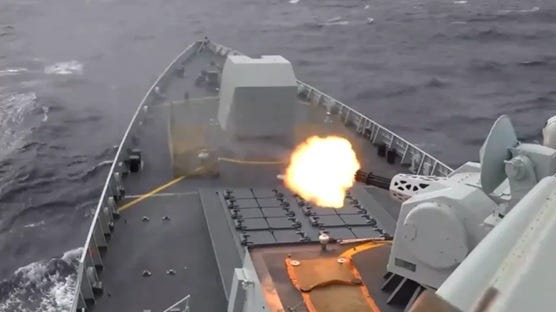
Japan’s a very different matter. What’s a great power to do?
Well, they can issue travel advisories warning citizens to avoid Japan; economist Takahide Kiuchi estimates the loss of Chinese tourists could cost Japan over USD $14 billion. They can de facto ban Japanese seafood imports, holding them in port indefinitely while throwing up procedural roadblocks. There are already reports that Chinese authorities have massively stepped-up inspections of Japanese sake and other food products, doubling customs delays across the board. And now that China’s Ministry of Commerce (MOFCOM) are all back at the office after New Year’s, it’s time for export controls. On 6 January MOFCOM prohibited all exports of dual-use items to Japanese military end‑users, for military end‑uses, and to any other end‑uses that would contribute to enhancing Japan’s military capabilities.
MOFCOM did pretty much the same thing in January last year to 28 named US companies, mostly large defence contractors like Raytheon and Boeing, but this time there’s neither an entity list attached nor a pathway to apply to MOFCOM for special permission. Not only Chinese exporters, but international re-exporters of Chinese-origin dual-use items will need to demonstrate to MOFCOM’s satisfaction that they won’t end up supporting the JSDF. While MOFCOM later clarified that the ban will not affect ‘civilian users’, its scope is still extraordinarily vague: up to 42% of Japan’s annual imports from China (worth some USD $68.4 billion) could be affected. Rare earth elements appear to be a particular concern: on top of the controls imposed on 6 January, Chinese state media have indicated the intent to enforce more stringently China’s pre-existing export controls for rare earths, specifically where Japan is the destination. While the effects of all this aren’t expected to hit until next month, it’s worth noting that the rare-earth card is one China’s dealt Japan before—with limited success. So far Tokyo seems to be biding its time. With a snap election on the way, Japan’s government has made diplomatic protests, but so far taken no formal economic countermeasures.
Laying down the law
Late last year Taiwan’s legislature voted to amend the Telecommunications Management Act, among six other laws, to raise penalties for intentional damage to undersea cables. The amended laws became effective on 7 January. The new legal framework was drafted by the Executive Yuan in reaction to a sequence of suspected cable sabotage incidents in early 2025, attributed to Chinese-crewed vessels operating under flags of convenience. They increase the criminal penalties for intentional damage to critical undersea infrastructure, empower Taiwanese authorities to confiscate tools, vessels, and equipment used to illegally endanger undersea cables regardless of ownership, and make it legally obligatory for vessels within territorial waters to report their location and movements through the Automatic Identification System (AIS). The new laws also require the Ministry of the Interior to publish maps and data on undersea cable locations, making it harder for offenders to claim ignorance.
The Great Wall of the East China Sea
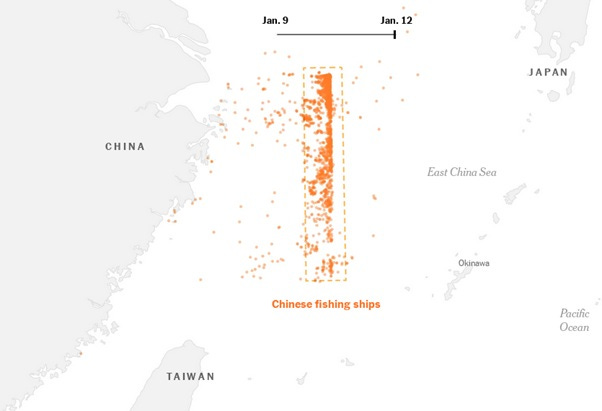
Speaking of AIS—if you happened to be monitoring AIS ship location data in the Western Pacific on about 11 January, you would have noticed something quite odd. About 1,400 Chinese fishing boats dropped whatever they were doing and made a beeline for the East China Sea, where they arranged themselves into a line about 300 kilometres long. What you’d have been seeing there was the Chinese maritime militia, or a significant part of it, showing off an unprecedented degree of coordination. Chinese authorities are yet to comment, but expert opinion finds it unlikely they were all there to fish; the point is taken that, in a crisis, China could not only mobilise but effectively command vast numbers of nominally-civilian vessels to support military activities.
Ground control to Major Kim
After a two-month lull, North Korea kicked off the year with at least two ballistic missile tests in the early hours of 4 January (2250 UTC, 3 Jan). It’s as yet unconfirmed whether—per DPRK media’s claims—these were hypersonic missiles. In keeping with the recent trajectory of the DPRK missile program, these were short-range systems whose projectiles splashed down in the Sea of Japan after about 1,000 kilometres of flight. While Pyongyang disclosed a new ICBM in late 2025, there haven’t been any ICBM tests since 2024. Their efforts over the last year have focused on maturing theatre-level weapons, probably with a view to courting the Russian export market.
Signalling matters a fair bit with North Korean missile tests, but in this case, while the timing is suggestive, the intent is open to interpretation. The launches came only a few hours after US special forces captured Venezuelan President Nicolás Maduro in Caracas, and a few hours before South Korea’s president Lee Jae Myung flew to Beijing for leader-level talks. Things are complicated by North Korea’s questionable claim the following week to have shot down a South Korean surveillance drone on 4 January. In remarks to state media, Kim Jong Un characterised the tests as a demonstration of the DPRK’s nuclear deterrent, and said they were made necessary ‘by the recent geopolitical crisis and complicated international events’—without further elaboration.
For more on these topics, we suggest:
Pressure Points (ASPI, 2025)—Beijing’s growing use of military coercion against Taiwan.
The Old Logic Behind China’s New Economic Weapons (The Washington Quarterly, 2025)—When, how, and why does China use economic sanctions?
Disrupting the Gray Zone: Unrestricted Warfare in the Pacific (USNI, 2025)—On the Chinese Maritime Militia.
New Missiles But Fewer Launches, a Missile Sub Reveal, and a Nuclear-Armed Air Force (38 North, 2026)—North Korea’s missile program during the last quarter of 2025.
Southeast Asia
Sir, do you know how fast you were fishing?
On 12 January, about thirty kilometres southeast of Scarborough Shoal in the West Philippine Sea, the Philippines-flagged fishing boat Prince LJ was harassed by a China Coast Guard vessel (CCG 23521) and a PLA Navy vessel (PLAN 621). The Chinese ships blocked the Prince LJ’s path, forcing it to change course to the southeast, pursuing it while blaring sirens. A Philippine Coast Guard vessel arrived after approximately three hours and began documenting the encounter. This was the first incident this year of harassment from Chinese security forces recorded by Philippines sailors inside the Philippines’ Exclusive Economic Zone (EEZ), in an area which is also claimed by China as part of the ‘nine-dash line’. This area saw a marked rise in Chinese maritime activities over 2025: Philippines authorities recorded 447 military and law enforcement vessels, up from 278 in 2024. As part of an increasingly persistent posture in contested areas, it’s become more common in recent years for China Coast Guard vessels within the ‘nine-dash line’ to be shadowed closely by PLA Navy warships—though as the August 2025 collision between two such vessels indicates, joint operations might not be perfected. This latest incident comes only a few months after China’s State Council approved a plan to create a nature reserve at Scarborough Shoal.
Beachfront property, if you can keep it
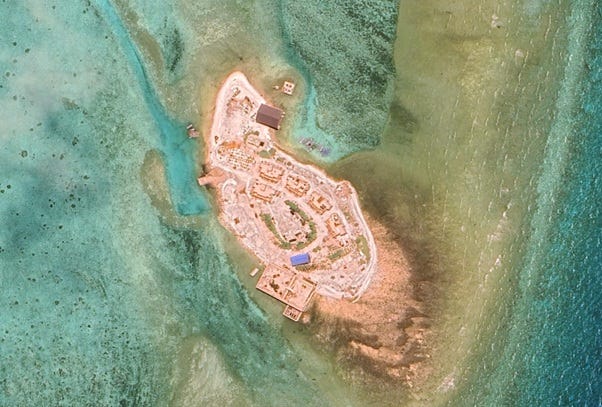
At Antelope Reef in the Paracel Islands—a sandbar about 200 metres end-to-end, claimed by China, Vietnam, and Taiwan—the dredgers are back. Recent satellite imagery indicates a flurry of new land reclamation activity at Antelope, which presently hosts a small Chinese outpost. Since last November new infrastructure has been built on the reef, including a roll-on/roll-off berth—which suggests plans to move heavy equipment onshore, consistent with a large-scale dredge. If that comes about, it’ll be China’s first major land reclamation since the 2013-2016 period of extensive dredging in the Spratly Islands. Chinese activity in the South China Sea since then has been characterised more by consolidation and militarisation of the land reclaimed in that earlier phase, while other players have used the interval to push forward with their own island-building efforts. Vietnam’s work since 2021 has nearly matched, if not surpassed, China’s earlier build-out.
Professionals talk logistics
On 15 January Japan and the Philippines signed a mutual logistics support agreement, allowing both countries’ armed forces to exchange supplies and services tax-free. It follows on from and strengthens the Reciprocal Access Agreement (RAA) the two countries concluded in July 2024, which entered into force in August last year. The RAA creates a legal framework for each country’s armed forces to enter and operate within the other’s territory.
For more on these topics, we suggest:
Maritime Incidents in the South China Sea: Measures of Law Enforcement or Use of Force? (International Law Studies, 2024)—Where do the tactics of the China Coast Guard stand under international law?
Island Tracker (AMTI, 2026)—Five claimants have built more than 90 outposts in the South China Sea. Who owns what?
Japan’s Defense Cooperation with the Philippines under the Free and Open Indo-Pacific (FOIP) Initiative (NIDS, 2025)—A quasi-alliance is gradually coming into existence between Japan and the Philippines.
Southeast Asia’s evolving defence partnerships (Lowy Institute, 2025)—Deepening Japan-Philippines defence cooperation in broader context.
Oceania
Whatever floats your boat
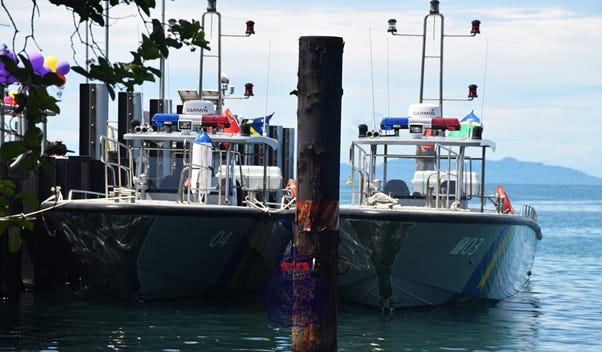
Two speedboats of Chinese manufacture were handed over to the Royal Solomon Islands Police Force on 13 January, in a ceremony attended by the Minister of Police and the PRC’s Ambassador. This is the first time the PRC’s made a gift of this kind to the Solomon Islands, with which it concluded a Security Cooperation Framework in April 2022. Boat donations—whether they’re the armed patrol boats characteristic of Australia’s Pacific Maritime Security Program, hydrographic survey vessels capable of playing a surveillance role, or small police craft driven by outboard motors—have become increasingly salient in external actors’ security engagement with the Pacific Islands over the past decade. Excluding Australia’s long-standing defence cooperation program, since 2018, Japan, Taiwan, South Korea, China, the United States, New Zealand, and most recently India have gifted vessels of various kinds to support Pacific coast guards and police forces.
For more on these topics, we suggest:
Global policing: China’s police training in Solomon Islands (IISS, 2025)—Since 2022, China has rapidly expanded its police-training programmes with the Royal Solomon Islands Police Force.
Friends to all: Solomon Islands juggles security partners in search of maximum support (ASPI, 2025)—On the Solomon Islands’ approach to security cooperation.
That’s all for this fortnight. For more timely analysis and commentary, check out The Strategist and ASPI’s Stop the World podcast.