
Fault Lines 007: Wheeling and dealing
South Korea’s force restructure | Indonesia’s art of the deal | US Marianas footprint under pressure

Welcome to the latest edition of ASPI’s Fault Lines.
Each fortnight, ASPI’s Defence Strategy Program monitors the moves and countermoves shaping the regional order and Australia’s security.
This edition covers the period 3 April 2026 - 16 April 2026.
Follow the Australian Strategic Policy Institute on X, on LinkedIn, and on Bluesky.
Northeast Asia
People, ideas, machines—in that order
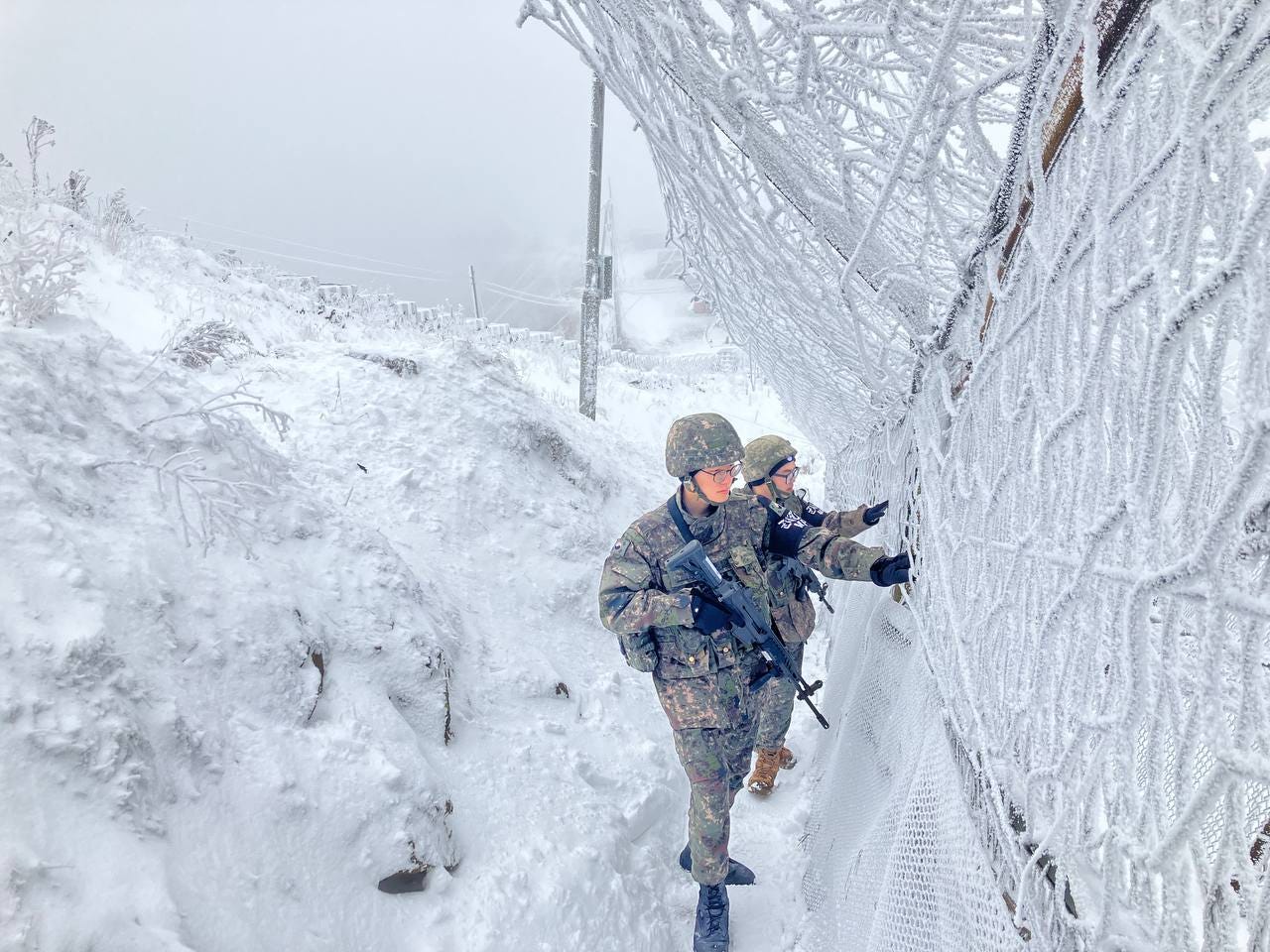
On 7 April, South Korea’s defence minister Ahn Gyu-back revealed plans to cut front-line guard forces from 22,000 to 6,000 along the Demilitarised Zone (DMZ)—that 248-kilometre monument to barbed wire which has sufficed for an inter-Korean border since the 1950s. The idea is that three-quarters of the current force staffing outposts on South Korea’s side of the DMZ (and inside it) will be pulled back to rear combat positions, while those remaining on the front line will be supplemented by a suite of AI-enabled surveillance systems. North Korea’s been remilitarising its side of the DMZ at scale since 2023, so anything resembling a deliberate lowering of the South’s readiness, and a cut to the DMZ guard force in particular, must have been a tough sell. Two days after the announcement, Ahn had to clarify that—like all sound policy—it’ll be done gradually, after phased review, by the year 2040.
While this is the first time Korean officials have provided specifics of a plan to do so, the general idea of supplementing and/or replacing border units with high-tech surveillance systems has been around for a few years. Field trials of such systems in 2024 fed into the previous conservative government’s flagship reform initiative (Defense Innovation 4.0) and if you go back to President Yoon’s 2022 Defense White Paper you’ll find an ambitious scheme to replace the whole border security apparatus with an ‘AI-based boundary system’ by 2026. It’s not surprising that didn’t happen. The DMZ is a mountainous place, heavily vegetated, that’s prone to fog, snowstorms and monsoons. Automating surveillance in that environment is a considerable technical challenge, and it’ll probably take a while for Seoul to build a system they can rely on.
Behind all of this is demographics. Like Japan, South Korea has an ageing society and fertility rates far below replacement. But the need to conscript from a smaller population to maintain a force that’s relatively large (about one percent of South Koreans are currently on active duty) means that a shrinking military-age cohort is potentially a much bigger problem. Over the last twenty years, Korean governments left and right have aimed defence policy in one direction: a smaller army and a higher-tech, more capital-intensive force structure. Ahn’s remarks last week were quite candid on this point, and the cuts to forward positions on the DMZ were only one part of a broader plan, yet to be given President Lee’s approval, to relieve demographic pressure. The proposed reforms include shifting responsibility for coastal surveillance from the Navy to the Korea Coast Guard, and outsourcing rear-area base security to private contractors. There’s also a notion of reforming conscription, creating 50,000 new technology-specialist NCO roles as alternative to the usual mandatory service.
Pyongyang has of course been watching all this with interest. Recent missile tests showcased the North’s new cluster munitions, an electromagnetic warfare system (of unclear characteristics), and what it claimed to be a graphite bomb designed to disrupt power grids and military electronics. That’s a capability Seoul is approaching too, and the North’s pursuit of it is an indicator of how both Koreas, in their own way, continue to move in a broadly similar direction: away from the traditional mass-army concepts, and toward high-tech conventional and electronic warfighting.
News from abroad
Russia’s foreign ministry summoned the Japanese ambassador in Moscow last week, and gave him an earful. Turns out the relationship’s at an all-time low due to the ‘unfriendly policy’ of the Takaichi Government. The immediate cause of this incident was an agreement made by Japanese UAV manufacturer Terra Drone on 31 March to invest in the Ukrainian firm Amazing Drones.
This is the first known partnership between a Japanese manufacturer and Ukraine’s military drone sector. If the bumper appropriation for drones in Japan’s next defence budget is any guide, it won’t be the last. Japan wants a layered architecture of uncrewed defensive systems, and Ukrainian industry has the know-how.
China’s foreign minister Wang Yi visited Pyongyang on 9-10 April, for the first time since 2019. North Korea’s recent pivot to Russia has made things a bit tense over the Yalu River, and this trip looks a lot like an effort to reset things. Hard to gauge success here; while much highfalutin language and comradely reaffirmation came out of both countries’ foreign ministries, few concrete outcomes are visible thus far.
Xi Jinping met the leader of Taiwan’s main opposition party—KMT chair Cheng Li-wun—during the latter’s trip to mainland China on 10 April. There hasn’t been any official contact between Xi and a Taiwanese President for a decade, so the opposition leader getting a handshake is something of a jab at President Lai.
ASPI’s State of the Strait has the details.
Southeast Asia
A maze of hedges
It takes a certain kind of foreign policy for a president to sit down with Vladimir Putin and agree to long-term cooperation in the energy and minerals sector—on the very same day his defence minister is in Washington signing up to a new defence partnership. But Indonesia is a certain kind of country, and President Prabowo Subianto’s ‘free and active’ approach to foreign affairs produces ironies like this on the regular.
With a quarter of its crude oil imports behind the Strait of Hormuz—and only twenty days’ reserve at home—Indonesia’s interest in a seat at Putin’s table is very obvious. Prabowo’s energy minister duly brought home an agreement to buy Russian crude and LPG. Considering Russia’s been using Indonesian ports to get around Western sanctions on its oil for a while now (Jakarta denies all knowledge of this) one would hope they’re getting a discount.
On the US side, the Major Defense Cooperation Partnership mostly repackages existing capacity-building and joint training initiatives from the Defense Cooperation Arrangement, with a handful of new elements such as ‘co-developing sophisticated asymmetric capabilities’. What’s more interesting is what’s not in it. On 13 April, Indonesia’s defence ministry notified media that leaks of an American-proposed arrangement to give US military aircraft ‘blanket overflight access’ to Indonesian airspace were genuine—but that the documents were drafts for interagency discussion, not policy, and that nothing was final. The new MDCP, an Indonesian official emphasised the next day, does not contain any such agreement.
Streamlined access to Indonesia’s voluminous airspace would be rather valuable for the US military, particularly if they had a mind to operate aircraft out of, say, bases in northern Australia. It’d also be a very overt signal of US alignment on Jakarta’s part—the sort of thing they’ve made a trademark of not providing. Quite how the Pentagon got Indonesia even this close to a deal over airspace is a mystery.
Wax on, wax off
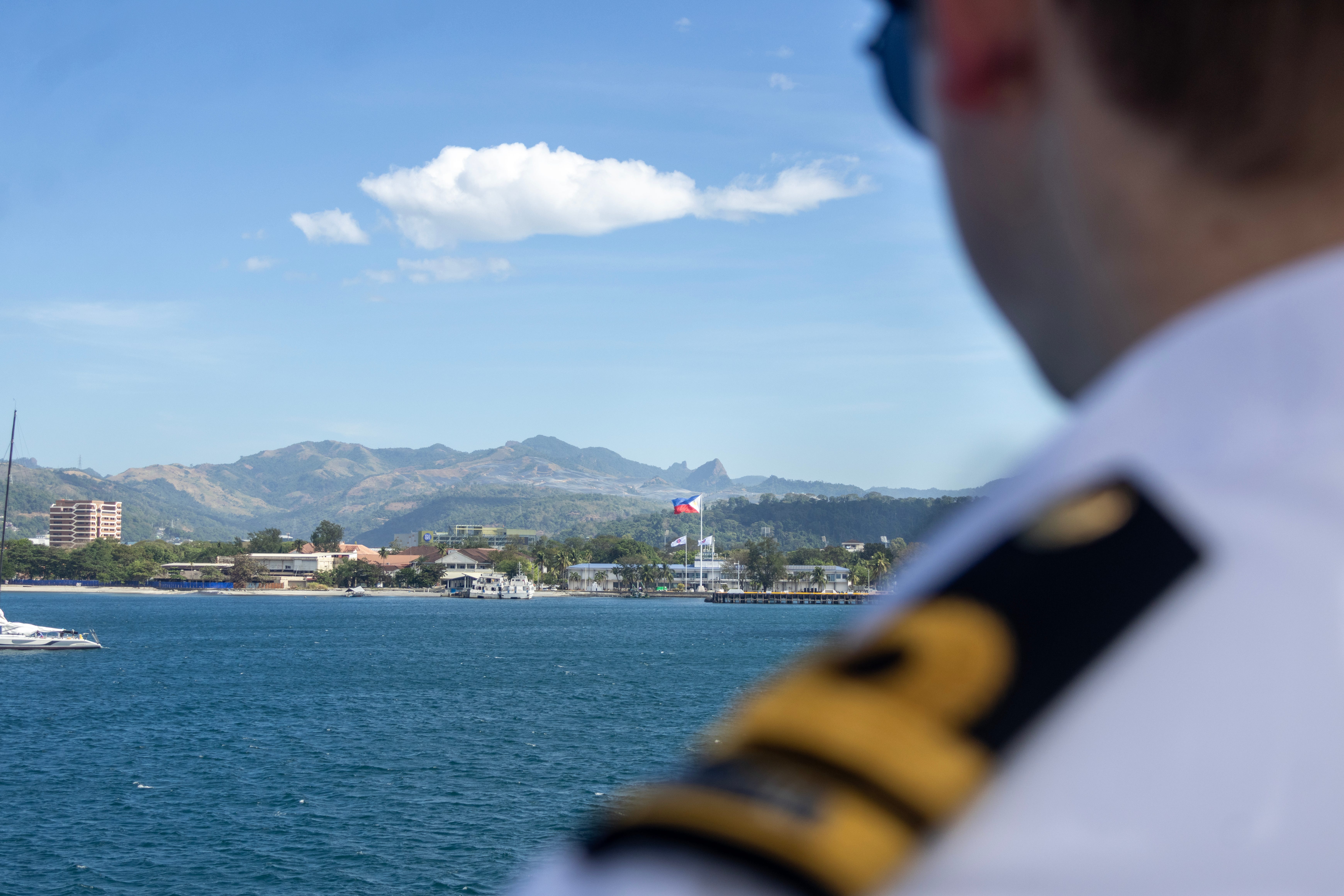
Barely three months into the year, the South China Sea has already seen 2026’s fifth joint maritime exercise between the US and the Philippines—the second this year to feature Australian participation. From 9-12 April, naval and air elements from the three countries combined to test interoperability on a range of tactical manoeuvres, communications and logistics tasks. Those elements included the frigate HMAS Toowoomba, which took part the first time back in February—somehow managing to squeeze sanctions enforcement on North Korea, a joint exercise with Japan, and the contractually-obligated unsafe interaction with the PLAN into the interim.
These joint exercises, which kicked off in 2024, are an increasing part of what regional presence looks like for the Royal Australian Navy. They aren’t quite training for a high-end fight, but that’s sort of the point: partner militaries need to nail down the basic, unspectacular parts of working together at sea to demonstrate a credible deterrent posture, and Washington and Manila have spent the last few years drastically increasing opportunities for their forces (and regional partners) to build that kind of collective muscle memory across all domains. The Mutual Defense Board and Security Engagement Board—the annual meeting between the chiefs of US Indo-Pacific Command and the Philippines Armed Forces—approved 281 security cooperation activities for 2019. For 2026 they’ve approved over 500.
That’s a qualitative change as well as quantitative one. Exercise BALIKATAN—the primary annual US-Philippines warfighting exercise—will commence for this year on 20 April, bigger than ever. Not only will Japan take part as a full participant rather than an observer this time, but—as the JSDF Joint Staff recently revealed—its contingent will run to over 1,400 personnel, much larger than anticipated.
News from the neighbours
Singaporean think tank ISEAS released its 2026 State of Southeast Asia survey report the other day. The result that’s making the headlines: if forced to choose between partnering with China or the US, ASEAN sentiment now averages 52% pro-China, 48% pro-US.
Check the full report, though: ASEAN is still on average more worried about China’s political and strategic influence than America’s. But the gap is narrowing.
Vietnam’s president To Lam is in Beijing on a state visit from 14-17 April—his first overseas trip since Vietnam’s ruling Communist Party (of which he is, by sheer coincidence, General Secretary) elected him president in February.
The meeting will follow up on the inaugural ‘3+3’ strategic dialogue last month and is likely to cement a stronger focus on security cooperation in the relationship—including a potential agreement to import Chinese surveillance tools.
On 4 April the Royal Cambodian Navy took delivery of the first of two Chinese-built Type 056C guided missile corvettes. The second one’s expected in June. This is major step-up for the RCN. Where previously they operated only small coastal patrol boats, the Type 056C is a genuine (though still fairly small) modern surface combatant, with missiles and a multi-domain sensor fitout.
They are, moreover, a donation—not a purchase—from Beijing.
Oceania
The perfect storm
The Northern Mariana Islands, an US external territory north of Guam, are ‘key to reinforcing the US military’s presence in the Indo-Pacific’—thus stated US Assistant Secretary of War for Indo-Pacific Affairs, John Noh, in reply to an official delegation from the Marianas who’d written recently to President Trump. The delegates wanted government help to ward off a deepening economic crisis. The crisis was triggered by the collapse of tourism revenue after COVID. Much of that tourism came from China and is unlikely to return, particularly after direct flights from the PRC ceased in 2024. The situation has worsened due to soaring fuel prices in the wake of the conflict in the Persian Gulf. Noh acknowledged the problem and, without committing to specific policy changes, indicated the Pentagon will step up its engagement with the Marianas in response.


That engagement is already concrete. Several airfields across the archipelago are currently being upgraded; the island of Tinian is to be transformed into a major US Air Force hub through a US$409 million revamp. The idea is to bring Tinian’s North Field—unused since the Second World War—back online as an alternate base of operations to Anderson AFB on Guam, which is one of the largest and most strategically important in the Pacific. Prior to the Iran war, USINDOPACOM commander Admiral Samuel Paparo expressed concern about how the islands’ struggling economy could hamper US military efforts in the territory, noting the islands’ civilian infrastructure and community wellbeing are ‘inextricably linked’ to the US’s ability to carry out military operations in the region. Paparo too called on the federal government to act to assist the territory.
Assistance will now be far more urgent. As if their economic woes weren’t bad enough, the Northern Marianas were hit by Super Typhoon Sinlaku this week. There’s been severe damage to homes and infrastructure—on Tinian in particular. The US government has pledged financial support, and a military task force under USINDOPACOM has been readied to deliver disaster relief. The impact of the storm on the USAF’s redevelopment projects is unknown.
What’s notable here is that Sinlaku is unusually strong and unusually timed. Northwest Pacific typhoons are normally a July-November thing, and this one’s appearance in April makes it one of the strongest off-season typhoons on record—about on par with last year’s Hurricane Melissa, which devastated the Caribbean to the tune of some US$48 billion. It’s a pointed reminder, not only that the Pacific operating environment is volatile in both human and non-human terms, but that volatility itself is getting harder to price in—though a persistent US posture will need to try nonetheless.
News from the family
The French Parliament rejected without debate the government’s constitutional reform bill on the status of New Caledonia.
The bill—initially agreed to by 5 out of 6 New Caledonian political parties in the wake of the 2024 riots—called for a ‘state of New Caledonia’ within the French republic and a distinct New Caledonian nationality in addition to French citizenship. The bill was rejected at the urging of pro-independence New Caledonian MP Emmanuel Tjibaou, stating the bill was a ‘model of internal autonomy, not external decolonisation’.
The Cook Islands and New Zealand have signed a new security declaration, ending the spat caused by the Cook Islands’ 2025 comprehensive strategic partnership agreement with China.
The declaration affirms New Zealand as the Cook Islands’ ‘partner of choice’ and commits to consultation with New Zealand before signing on to any pacts with third parties. New Zealand’s Foreign Minister, Winston Peters, said the declaration limits the scope of the Cook Island’s deal with China.
The PLAN hospital ship Silk Road Ark docked in Port Moresby this week, the latest stop on this year’s iteration of the annual ‘Mission Harmony’ medical diplomacy initiative. The Ark’s crew offered free medical care—including surgeries—for local residents.
Papua New Guinea’s Prime Minister, James Marape, dined aboard the vessel with PLAN officers at an official reception on 14 April.

That’s all for this fortnight. For more timely analysis and commentary, check out The Strategist and ASPI’s Stop the World podcast—or elsewhere on Substack:


Interesting that both Koreas are moving toward more tech-enabled force structures, but for very different reasons. South Korea is adapting to demographic decline. North Korea appears to be compensating with asymmetric and electronic capabilities.