
Fault Lines 012: Building bridges
Russia-North Korea land bridge nears completion | China sanctions Philippine defence minister | Tug-of-war over Bougainville independence

Welcome to the latest edition of ASPI’s Fault Lines.
Each fortnight, ASPI’s Defence Strategy Program monitors the moves and countermoves shaping the regional order and Australia’s security.
This edition covers the period 11 June 2026 - 25 June 2026.
Follow the Australian Strategic Policy Institute on X, on LinkedIn, and on Bluesky.
Northeast Asia
A bridge too short
Somewhere in the bundle of agreements that Russia and North Korea signed in 2024 was a promise to build a road bridge between the two countries. It’s a bigger deal than it sounds. There’s been a rail crossing since 1959—heavily used in the wake of Pyongyang’s decision to back Russia’s war in Ukraine—but never anything driveable unless you have a lot of faith in the Tumen River’s winter freeze. That bridge is now nearly complete, though not quite in time for the two-year anniversary of the Putin-Kim handshake on 19 June as planned. Customs facilities and connecting roads on the Russian side are yet to be finished.
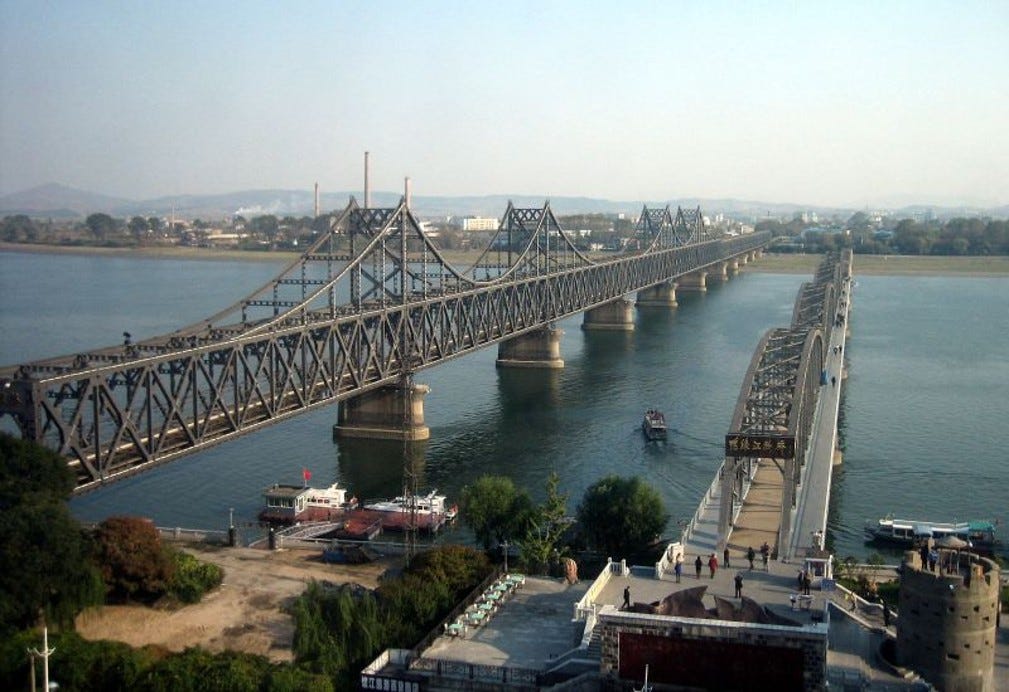
Chalk that up to the dubious Chechen construction firm, if you like; seen from Pyongyang, the story is ironically familiar. Pan the camera to the other side of the country and you’ll find the New Yalu River Bridge, a sleek, ultra-modern 3,000-metre span completed at great expense to the Chinese taxpayer back in 2014 and so far totally useless, as the necessary facilities on the North Korean side were never finished.
Both bridges could be economically significant for the North. The Russia one has the potential to admit 300 trucks a day—that’s in the same neighbourhood as what currently goes over the Yalu at the Dandong-Sinuiju crossing on a busy day. This in turn is a hefty portion, perhaps as high as 60-70 per cent, of the North’s trade with China—still by a huge margin its most important economic relationship. And right now, the only way to drive cargo from the Chinese border city of Dandong to the other side of the river is a rather rickety single-lane bridge built by the Imperial Japanese Army in 1943. The much larger and wider New Yalu River Bridge is meant to replace it.

But economic arguments alone have a hard time getting over the North Korean border. Even now that the North’s economy is improving and (since early 2025) construction on their side of the Yalu has finally begun progressing, the regime’s habitual suspicion of foreign trade and the outside world in general is still much in evidence. Cross-border bridges are as much about facilitating an economic lifeline as they are about politically managing dependence on that lifeline—and in that sense, even a Russia bridge that’s not yet open is a political signal.
The complication is, the Tumen is mostly a Chinese river; walk a few minutes from the new Russia-North Korea bridge and you’ll find yourself in Jilin Province. It’s only the last seventeen kilometres before it empties into the Sea of Japan that China doesn’t control—one of many concessions Russia extracted from the Qing Dynasty in the nineteenth century. For decades Beijing has been trying to secure freight access through the Tumen, giving its far north a direct route to markets in Japan and beyond; for decades it’s been frustrated, among other things by the fact that the existing Russia-North Korea rail bridge is only seven metres above the water, making it practically impossible for Chinese ships of any serious proportions to reach the ocean. The new road bridge, as far as one can tell, has been built at the same height.
News from abroad
Speaking in Luxembourg on 15 June, EU High Representative Kaja Kallas claimed that the EU now has ‘verified reports’ that the Chinese military has been training Russian forces to fight in Ukraine.
At first glance, that seems counterintuitive; the Russians are the ones with combat experience, so you’d think the historically war-shy PLA would be coming to them. The EU intelligence assessments Reuters got their hands on last month—which Kallas’ remarks now seem to have confirmed—suggest the training was small-scale, centred around upskilling a select group of Russian personnel (many of them military instructors themselves) in combined-arms tactics with heavy use of uncrewed systems.
Another special defence budget request—about US$6.6 billion primarily earmarked for buying drones and uncrewed systems—was presented to Taiwan’s legislature on 18 June. Much of this is money that was cut from the Lai government’s earlier special budget when the opposition-controlled Legislative Yuan passed a stripped-down version back in May.
Taiwan’s National Security Bureau launched a new citizen reporting website on 14 June. Not their citizens, mind you; the idea is to give disgruntled residents of the People’s Republic a secure online ‘dead drop’ where they can pass intelligence to Taipei.
ASPI’s State of the Strait has the details.
President Lee Jae Myung’s first Defense White Paper is in the works, and there’s something of a wrangle about whether it should refer to North Korea as the South’s ‘principal enemy’.
The last white paper—a rather hawkish document composed under the increasingly ill-fated president Yoon in 2022—did exactly that, and on 18 July the defence ministry in Seoul indicated the ‘enemy’ wording wouldn’t be dropped. Only hours later, in a briefing to reporters, the Ministry of Unification argued that Lee’s stated goal of ‘peaceful coexistence’ between the two Koreas was fundamentally inconsistent with treating Pyongyang as an enemy.
Southeast Asia
Persona non grata
The Philippines’ defence minister Gilberto Teodoro and his immediate family have been sanctioned by the Chinese government on 11 June. Probably something to do with his remarks at the Shangri-La Dialogue earlier. Teodoro is barred from entering the PRC, Hong Kong or Macau, and Chinese businesses and individuals are prohibited from any kind of contact with him. While former officials and senior legislators have been fair game in the past, this is the first time—as far as we know—that China has sanctioned a serving cabinet minister of any country other than Taiwan.
Under other circumstances, this would be the diplomatic nuclear option; it’s tough to sustain high-level dialogue when one country’s defence minister is legally prohibited from engaging with the other’s. But given where Manila and Beijing already are, the operational impact is limited. You might recall Teodoro himself refused to speak with his Chinese counterpart at the ASEAN Defense Ministers’ Meeting last November. Most of the key bilateral arrangements (like the regular China-Philippines Bilateral Consultation Mechanism on the South China Sea, which is exactly what it sounds like) are wired through the two countries’ foreign ministries instead. So this is less about pulling the plug on an extant defence-ministerial dialogue, than Beijing making it clear there will not be one while Teodoro is on the other end.
Man of the hour
Myanmar’s leader, Min Aung Hlaing, got the full red-carpet treatment in Beijing during his state visit from 15-19 June: bouquet on arrival, PLA guard of honour, 21-gun salute, Golden Hall banquet—a real class act. Eighteen MoUs rounded out the trip.
While he’s visited China before as head of the military junta, Myanmar’s (now notionally civilian) leader hasn’t previously received the full head-of-state treatment. India—which was Min Aung Hlaing’s first destination abroad as president a few weeks earlier—pointedly withheld those honours, and kept media coverage to a minimum to avoid overtly legitimising the government in Naypyidaw. China has done the exact opposite. In the joint statement, it’s gone as far as calling for Myanmar’s ‘full, equal and constructive’ participation in ASEAN mechanisms and the UN—from both of which the junta has been barred since the 2021 coup.
News from the neighbourhood
The same day he got sanctioned, Teodoro signed a Mutual Logistics Support Arrangement with Canada’s defence minister David McGuinty. It’s the fourth agreement of that kind Manila’s made since 2021—Australia, New Zealand, and Japan holding the others—on top of a similar long-standing arrangement with the United States. Like those, the Canadian MLSA has an accompanying Status of Visiting Forces Agreement—Canada’s was signed a few months back—includes an underlying political commitment to deeper defence cooperation.
The logistics arrangement allows the two forces to exchange logistical support during combined exercises, training, deployments and operations. It builds on the Philippines–Canada Status of Visiting Forces Agreement signed in November 2025.
Oceania
Moving target
Earlier this month, Papua New Guinea’s government made a surprise announcement: while the PNG parliament will soon vote on whether to ratify Bougainville’s non-binding 2019 independence referendum, that vote will now require a three-quarters majority to pass.
The president of the Autonomous Bougainville Government (ABG), Ismael Toroama, probably isn’t alone in suspecting Port Moresby of putting its thumb on the scale. For a constitutional amendment—which this isn’t, though it’s sort of in the same neighbourhood—PNG generally requires two-thirds of the parliament to vote ‘yes’. Last week Toroama accused the PNG government of violating the 2025 Melanesian Agreement, which requires a vote in the PNG parliament to ratify the referendum outcome but says nothing about majorities, and called for the UN to step in. Meanwhile, the ABG’s vice-president, Ezekiel Masatt, has hinted at the possibility of a unilateral declaration of independence if PNG lawmakers don’t approve the referendum, although he noted the ABG is in ‘no rush to make that declaration’ and intends to continue the process in good faith.
Mind you, even if the three-quarters bar in the PNG parliament is met, the plan outlined by PNG Prime Minister James Marape on 22 June envisions a 15-year transition period in which Bougainville will be required to meet benchmarks on financial self-sufficiency, peace and stability before independence can be granted. If the vote fails, it’s also a 15-year transition period, in which, pending Bougainville’s achievement of other ‘agreed benchmarks’, the parliament will vote on the referendum again.

So, it’s independence by 2041 at the earliest—a long wait from the 2027 date provisionally agreed in 2021. The ABG, less than impressed by this timeline, has countered with its own: Bougainville proposes to prepare for greater self-government until September 2027, after which point it would be granted maximum autonomy until full independence in 2030. No comment as yet from Port Moresby.
All the while, recent talks between PNG’s foreign minister Justin Tkatchenko and his Australian counterpart Penny Wong to finalise the Pukpuk defence pact have been chugging along. Both countries, according to Wong’s statement to press, have completed domestic processes to ratify Pukpuk, which should enter into force ‘in the near future’. It could hardly be far from either minister’s mind that the Bougainville referendum—which returned a 97.7 per cent vote for independence—was a core element of the peace agreement that ended a ten-year conflict in 2001. The potential re-emergence of violence has been the subtext of all subsequent negotiations. If it does, it will become, in an increasingly concrete sense, Australia’s problem.
News from the family
On 16 June, regional media reported that French authorities had reduced polling stations in Nouméa from 57 to nine ahead of New Caledonia’s 28 June provincial elections. Independence advocates have criticised the move, arguing that it will disproportionately affect working-class indigenous Kanak voters—not incidentally, their main base of support.
New Caledonia’s much-anticipated provincial election—the first since the 2021 independence referendum—is set to take place after an over 18-month delay caused by the riots that resulted in the deaths of 14 people the last time it was attempted. Proposed voter reform is behind the unrest—specifically, attempts to politically enfranchise the one-fifth of New Caledonia’s population who remained ineligible to vote in local elections under the Nouméa Accord.
A watered-down version of voter reform passed the French parliament last month, granting 10,000 voters—all born in New Caledonia—the right to vote for the first time in the upcoming election. While controversial, unrest has not re-emerged, although some ATMs have been vandalised, telecommunications poles stolen, and alcohol sales temporarily banned until election day.
Meanwhile, French Prime Minister Sébastien Lecornu—who was recently reappointed to the post after he quit the role—has highlighted the risk of foreign interference in the election, citing the involvement of malign state actors’ in the 2024 riots (three guesses who that might be).
It’s now come to light that the Canberra trip made by Solomon Islands’ new prime minister Matthew Wale a few weeks ago had another item on the agenda: a Pacific-wide security pact.
While the vision of a ‘Pacific-led’ security architecture has generated plenty of rhetoric over the past decade, practical follow-through has remained piecemeal. A formal multilateral security treaty, if achieved, would mark a significant shift from the region’s current machinery that’s largely declarative, non-binding and dependent on political consensus rather than clear commitments.
Vanuatu will be excluded from Australia’s Pacific Engagement Visa ballot—a government program which annually offers permanent residency to about 3000 citizens of eligible Pacific states—for the coming financial year. The omission is notable; it’s the first time Vanuatu has been ineligible since the program was established in 2024.
That’s all for this fortnight. For more timely analysis and commentary, check out The Strategist and ASPI’s Stop the World podcast—or elsewhere on Substack:


This is why infrastructure has become the new battlefield of geopolitics. Ports aren't just commercial assets, they influence trade routes, logistics, naval access, and political leverage. Countries that control infrastructure often shape regional decisions without firing a shot.